Sunday, 3 May 2015
Humans Can Lick Too - Final Cut
Its been a long time coming, but here is my finished short film titled 'Humans Can Lick Too', a horror film based on a chilling urban legend. Please give it a watch and it would be awesome if you could leave some feedback for me, as I will need as much feedback as possible to effectively complete my evaluation questions. You can watch my film below, be sure to have the volume relatively high to get the full effect. I hope you enjoy it.

Saturday, 2 May 2015
Evaluation Question 4
How did you use media technologies in the construction, research, planning and evaluation stages?
Throughout the various stages of my film, from research to evaluation, I used a wide range of media technologies including digital cameras and professional standard audio and visual software such as Logic Pro X, for example. I used these various media technologies to further my skills while enhancing the final outcome of my film. Upon evaluation of the range of media technologies I have used at A2-level, it is clear to see that I have made a ginormous step up from last year when I produced a short film opening for AS-level. In this answer I will look at each of the stages of producing my final film in individual stages, and discuss, analyse and evaluate the use of media technologies in each one.
To begin with, before even thinking of starting to shoot my film, I needed to do a lot of research in order to know what I wanted to produce and how I would impress my target audience. I used the internet in a number of different ways when it came to my research. To begin with, I wanted to really familiarise myself with the horror genre so that I could start brainstorming my own ideas as well as laying the foundations for the key forms and conventions of short films in the horror genre. I used a range of tools that were available to me on the internet.
The first one I used was youtube, on this free video streaming site I could watch countless videos about horror conventions, from which I took notes, and also I could watch hundreds of other A2 level short films, of which most were horror films. Watching these short films made by other A2 students and watching horror convention and theory lecture videos allowed me to build a bigger understanding of the horror genre, gave me a better idea on what to put in my film in terms of conventions, and this experience also gave the idea of the standard of other A2 level student's work. Other sites I used included Vimeo, which is very similar to youtube. To get a more general feel for the horror genre, I used Netflix for a month; a movie and TV streaming service which has millions of films and TV programmes which are available whenever, or 'on-demand'.
 I used this to watch a few classic horror films including Hitchcock's 'Psycho' (1960) and the 1985 Wes Craven release, 'Nightmare on Elm Street'. Both these films gave me more and more ideas that I could integrate into my short film; Psycho was particularly good because of it's pioneering use of non-diegetic sound. Finally, a really good source of professionally-made short films were on hand by accessing the 'Short of the Week' website, a streaming website which was jam-packed with thousands of short films, including some excellently made horror films including one called 'Lights Out', which particularly inspired my own short film.
 Furthermore, I used the internet in one final other way to do research for my film. Through the use social networking sites such as Facebook and Twitter, I was able to contact people and ask them about what they thought of my film idea. This really did pay off as I posted about my idea in a particular Facebook group, which was made up of other Media Studies students, and I received loads of positive feedback about my idea, and points to improve on! Overall, in terms of research, a great range of media technologies were used, and they really did help me to do some valuable in-depth research that would aid me in producing my final short film.

 I used a Canon LEGRIA HF R38 3.28 MP Camcorder which could film in 1080p to shoot the film, and the end result was excellent. This camera was spot on when it came to shooting in low-light settings, and this was just what I needed, plus the camera was extremely simple to operate. Within two minutes of getting my hands on the camera, I was an expert! When it came to capturing audio, I always set up an AKG C214 condenser microphone going through an Alesis USB mixing desk and into my Macbook which was running Logic Pro X on set. I was originally going to use a Sennheiser MKH 6080 shotgun condenser microphone to capture audio for the film, but I was unable to use it as I could not mount it on my camera rig, and I was not able to rent one out on time. Despite this, using an AKG C214 condenser microphone still gave me some good sound, and it was much better than using the built in microphone on the Canon camcorder. To conclude, using the Canon HD camcorder and the excellent AKG condenser microphone meant that producing my film was easier, more efficient, and more to the point, the end product was really good. When it came to post-production, I used two key examples of media technology: iMovie and Logic Pro. I used iMovie to edit the film and bring the final product together. iMovie was great as it was straightforward to use and as it was on my macbook, editing was made into a very flexible process; I could pretty much edit my film anytime I felt like it, regardless of where I was, as long as I had it with me of course. Looking at Logic Pro X, I used it to process sound I recorded with the AKG condenser microphone. I needed to use it as I recorded delicate sounds such as footsteps and the dog licking sound which was much needed in my film. In Logic Pro X, I took the recorded sound, gave it a simple EQ and a compression mix every time to even out the dynamic range to make sure the audio was in its best state to be used in my film. Overall, using Logic Pro X and iMovie made life a lot easier because I did not have to rely on using the software on computers only in school, plus I was already very familiar with both the pieces of software.

Throughout the various stages of my film, from research to evaluation, I used a wide range of media technologies including digital cameras and professional standard audio and visual software such as Logic Pro X, for example. I used these various media technologies to further my skills while enhancing the final outcome of my film. Upon evaluation of the range of media technologies I have used at A2-level, it is clear to see that I have made a ginormous step up from last year when I produced a short film opening for AS-level. In this answer I will look at each of the stages of producing my final film in individual stages, and discuss, analyse and evaluate the use of media technologies in each one.
To begin with, before even thinking of starting to shoot my film, I needed to do a lot of research in order to know what I wanted to produce and how I would impress my target audience. I used the internet in a number of different ways when it came to my research. To begin with, I wanted to really familiarise myself with the horror genre so that I could start brainstorming my own ideas as well as laying the foundations for the key forms and conventions of short films in the horror genre. I used a range of tools that were available to me on the internet.
 |
| Horror genre documentary - 'Masters of Horror' |
Another way in which I used the internet in terms of research was how I used it to gather ideas for my own film. I used google's advanced search function to look up many websites that I could access and read about eerie stories that would eventually give me some inspiration for my own short film.
On the subject of planning, I used a very limited range of media technologies to plan my film. I mainly used the classic combination of my pen and lots of paper to brainstorm, write down script ideas, storyboard my film and write out filming plans and timetables. In terms of media technologies, I used Microsoft Word to produce a storyboard template which I could print off and sketch my ideas on to, and I used the calendar on my iPhone to keep a track of filming dates and deadlines.
Moving on, I'm going to discuss the abundant use of media technologies in the construction of my film; I'm going to divide it into the shooting of the film and post-production (all the editing) stages. When it came to shooting my film, I used two key pieces of media technology; a HD digital camcorder to film the visuals and a condenser microphone to capture the audio.
Finally I am going to look at how I used media technologies in the evaluation stage of producing my short film. There are 3 key things that I used: Powerpoint, iMovie and Blogger. I used Blogger to complete this section of the evaluation of my film, and I have used it to evaluate my ancillary tasks as well. Why iMovie? Well I used iMovie in the production of my VLOG, which is part of my evaluation. iMovie is a great and easy piece of software to use, but it still gives really professional results. To finish, I have used powerpoint as well in my evaluation; this is a piece of presentation software which allows you to produce really professional looking presentations that can even include audio!
Overall, I have used a range of media technologies to produce a quality end product, my short film, which is a real asset to all the time I have spent using different media technologies. The key media technology that I used was iMovie, the video editing suite that I used to edit my film. I was comfortable using iMovie, and it allowed me to therefore experiment with my editing skills and therefore improve my skills, bringing together a professional end product.
Evaluation Question 3
What have you learnt from your audience feedback? I have answered this question in the form of a VLOG post. Watch it below.
Evaluation Question 2
How effective is the combination of your main product and ancillary tasks? I answered this question in the form of a presentation.
Friday, 1 May 2015
Evaluation Question 1
Question 1 for my A2 Media evaluation was - In what ways does your media product use, develop or challenge forms and conventions of real media texts? I answered this question in the form of a radio show.
Thursday, 30 April 2015
Ancillary task - Magazine review
Hey! Here is my magazine review for my short film. Its a page from a magazine called FilmFan, enjoy.

Wednesday, 29 April 2015
Ancillary Task - Film Poster
Below is finished film poster for my upcoming short film titled 'Humans Can Lick Too':


Why did I go with this idea?
While I was pondering over ideas for my film poster during the shoot for my upcoming short film, I had a sudden flash of a poster in my head; and this is whats above. I wanted something clear, simple, intriguing and something that stood out. I think this poster ticks all these boxes: the title of the film written in blood clearly tells you that the film will be an extremely creepy horror film, the design is simple yet effective, and finally I think that the title of the film would certainly make you stop and ask questions - I mean what a weird name for a film right? But if you take a few minutes out of your busy lives to watch this film that the poster is advertising, the riddle will all become clear.
How was this poster produced?
I began by creating poster ideas within Microsoft Word, shocking I know, and when it came to my best idea, I took to the one and only photo editing suites: Abobe Photoshop. I began editing the title of the film that would go on the poster. I used my hands to wipe fake blood allover my bathroom's tiled walls, for the sake of the film. However, I took a few photos and decided to also use it on the poster. I started by putting the original photo into photoshop and then I painted around all the blood using a white paint brush tool.
I spent quite a lot of time zoomed in the image, slowly painting unwanted parts of the image with the white paint brush. Eventually I ended up with the image above. After doing this, I exported it as a PNG file and then I moved on to producing the other key parts of the film poster: the credits, film festival nominations/awards and the social media links. This did not take too long and in about one hour I had the finished product which you can see at the top.
What kind of feedback did I get about this poster?
After I began sharing this poster with my fellow peers and teachers, I received lots of positive feedback. People said that they admired the simplicity of the poster, but said that it caught their attention and they really liked the design. Others went on to give the reaction that I had hoped for; this reaction being that they were really intrigued by the poster because of the title of the film. They said if they had seen it on the high street or at the cinema entrance they would stop and ask themselves the question: what could this film be about? I have made sure that the poster does not give too much anyway. As always with feedback, I received some ideas on how to film poster could be improved. A small minority of people who I showed this poster too said that they would have liked to have seen more on the poster to make it more interesting. One person in particular said that a transparent and faded face of the main character behind the title would have made the poster more engaging. However, I did not make these changes because I wanted to keep my film poster really simple and I really wanted the blood written title to stand out and contrast with the white background.
What do you think about my poster? Any thoughts will be much appreciated, so just pop a comment down below on this post. Thanks for reading, have an excellent day.
Tuesday, 28 April 2015
Magazine cover
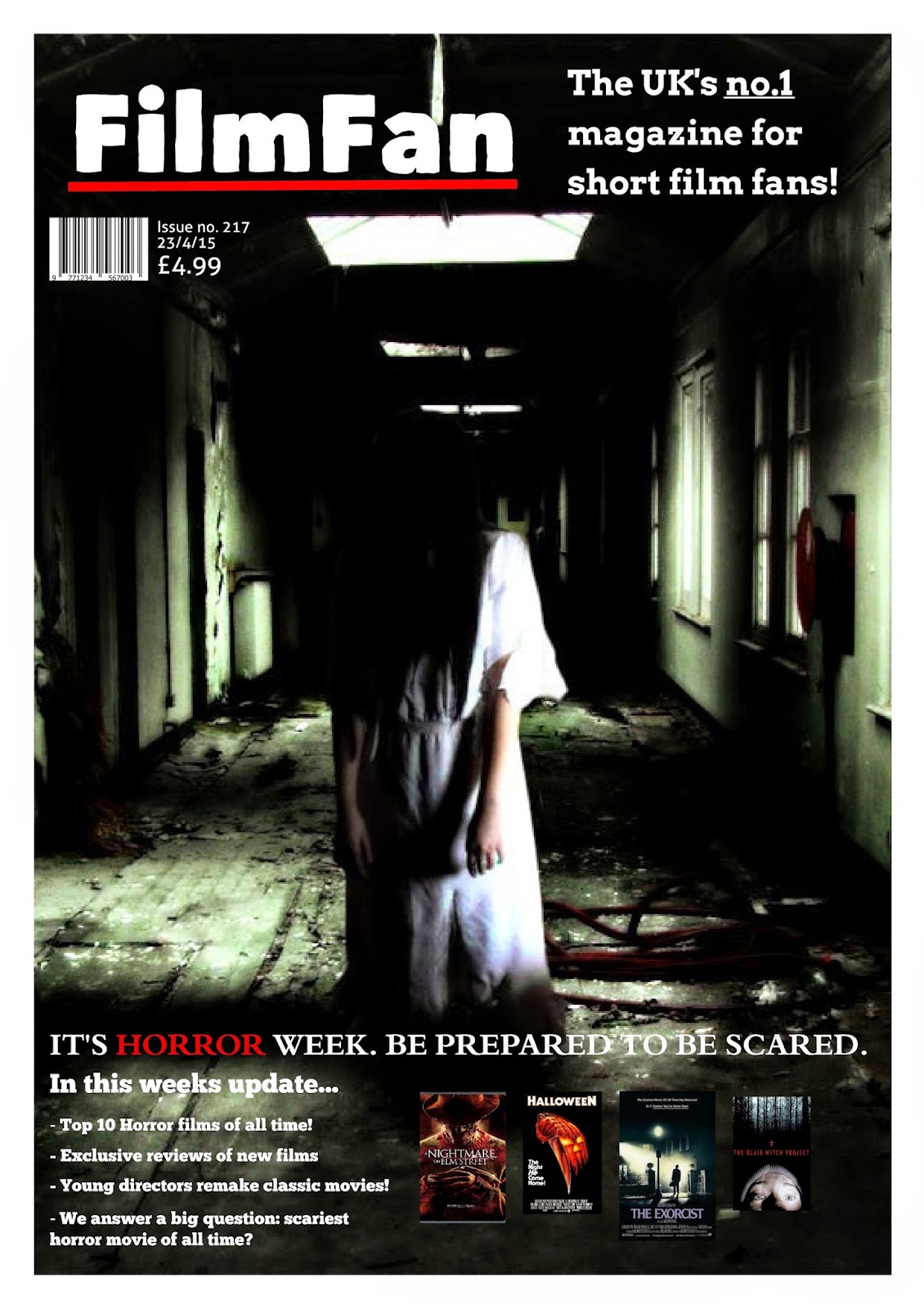
Hey guys! It's been a while since I last posted, but I've been really busy cracking on with my media coursework evaluation, which will all be on here by the end of this week. Last week, I finished my other ancillary task, the magazine review, which I'll post and talk about about separately, but for this post I just wanted to show you the front cover I made, as I had half an hour to spare. Here is the cover for the 'horror week' edition of FilmFan, the magazine I created which will feature a review about my short film.
Saturday, 7 February 2015
Date for your diaries
Hey all,
I can't wait to share this film with you guys!
I will be putting my finished short film on youtube on Monday, and it will be available to watch from midday. I will post a link to the film on here.
Interpreting Texts
During Wednesday's series of lectures, one of the other topics was how we interpret media texts. Matthew Hall, one the speakers, introduced me to the Stuart Hall's ideas about 'Encoding/Decoding' texts. Hall was a Jamaican cultural theorist and sociologist who was made famous for introducing this idea. So lets look at this idea; first of all when looking at a media text, we have to figure out what the dominant message is; what has the author encoded into the text? Next we have to think; what might be a negotiated interpretation? Basically, how does the audience decode the meaning, do they accept some of the author's intentions? Do they mis-interpret others? Finally we have consider what an oppositional or resistant interpretation is. How does the audience interpret the same text but generate an alternate meaning to that intended by the author?
 |
| Stuart Hall |
Thursday, 5 February 2015
Youth, Culture and Collective Identity
Yesterday I was at the 'Youth, Culture and Collective Identity' A-level study day at BFI Southbank. It was a day of lectures dedicated to our exam that we will doing in the Summer, and it was a very beneficial. The first section of lectures was on identity and collective identity.
We learnt about some important people to take note of, one of them being Jacques Lacan, a psychoanalyst who had developed a theory called the 'Mirror Stage', a stage at which child begins to develop their identity. Moving on from this, the lecturer (Matthew Hall) began to talk about psychoanalytic film theory and asked the question: how do we use the cinema and television as a 'mirror' to reinforce our identity? After this, Henry Jenkins was introduced, another theorist who believes that we need to interact in order to form our identity.
 |
| Jacques Lacan |
 |
| Henry Jenkins |
When we interact, our own identity is influenced by other people, also we may be interact and be heavily influenced by media representations. For example, if we see someone we really like in a film, we may aspire to be like them, and we may shape our identity to be like them. Other theories that exist are that we actively use these representations to reinforce our existing identity and show us how we should aspire to be, or we use media texts as a means to basis for collective identity (e.g Beliebers, TwiHards, Directioners).
Media trip!
The last two days have been awesome. Along with my media class, I spent two days in London doing some really fun stuff and attended an American youth study day at BFI Southbank on Wednesday. On the Tuesday I caught the 8:11am train from Spooner Row; the only train that stops there all day on the way to Norwich, yes, its a quiet place. We all met in Norwich and from there we got on the train heading directly to London Liverpool Street at 9am. Excitement was high and we were all looking forward to what lay ahead. We arrived in London and then got to the accommodation, dumping off our bags before heading out to Oxford Circus, where we took in the sights and sounds of the busy London street. The HMV there is crazy, I recommend it. After having possibly the best sandwich ever (6" Chipotle Chicken melt) from Subway, we all headed to the BBC where we went on an excellent tour of the news rooms and the BBC radio rooms.
The BBC news room was so lively. There was so much going on, and as we all stared down on the news room, the guide explained what actually goes on down there as well as talking about how news stories are verified and how the news presenters are journalists that work 12 hour shifts, working for hours on producing 75% of their own news report. I always just thought news presenters just read the news, but I was wrong; they are journalists themselves, not just news anchors. After this we hit up the BBC One Show studio, which was smaller than expected, and we were told about how its filmed and then we had the chance to sit down on the famous green sofa and get our photo taken. After this, we headed to the BBC radio 4 studio where bands such as Metallica, Coldplay and individual artists such as Justin Timberlake have recorded and performed to audiences. To finish off the tour, we were all taken through to a room where some microphones were set up; this is where BBC radio drama is recorded and as expected, we were able to act out and record our own radio drama. It was great fun and I learnt a lot of things that I did not know about the BBC. On the Tuesday evening, we headed out onto the dark and dingy backstreets of Whitechapel on a Jack the Ripper tour. This tour lasted around an hour and a half, and although it was bloody freezing, the tour guide made the trip extremely interesting and engaging. Being a great lover of history, it was fantastic to go on a tour and learn so much about the mysterious murders from someone called Jonny (like me), who has been studying the subject for 22 years! It was clear to see that he was an expert on the subject.
On the Wednesday morning we awoke to the comfort of a warm shower, unlimited coffee and unlimited croissants; score. After having far too much to eat, we headed off to the BFI for the American youth study day, which will I explain in depth in another post. After this, we headed to Camden Market to experience the excellent smells of exotic street food outlets and spend ages browsing through the various record shops. In the evening we caught the train back to Norwich and this excellent trip was drawn to a close. On the whole, the trip was really exciting and I learnt a lot of interesting stuff.
Anyway, today I'm back at school and the never ending grind of sixth form life can continue. Good day.
Sunday, 1 February 2015
More on camera angles
Earlier in this blog I looked at some basic camera angles which were the: worm's eye view, low angle, eye-level, high angle and bird's eye view angles. In this post I will be looking at another important camera angle that should be taken into consideration when making your own film, and it is quite common. First of all lets refresh our understanding of what camera angles are. Camera angles are the way that the camera is angled when filming takes place, and the job of a camera angle is to give emotional information to the audience, and guide the viewing audience with their judgement about the character or object thats in the shot. Heres an example for you; if there is a low angled shot of the main character, what we can draw from this shot is that the main character is dominant and powerful.
One of the key camera angles that I did not discuss in my earlier post was the angle known as the Dutch angle; otherwise known as the Dutch tilt, German angle or Oblique/Canted angle. To achieve this angle, the camera is not laid on a non-horizontal surface and therefore its on a sideways slant. This camera angle produces a sense that something is not right, because the camera shot is imbalanced and unstable, reflecting the situation on screen. This camera angle is often used in horror movies, in which scenes of uncertainty and pure horror need canted camera angles to further the scare factor.
One of the key camera angles that I did not discuss in my earlier post was the angle known as the Dutch angle; otherwise known as the Dutch tilt, German angle or Oblique/Canted angle. To achieve this angle, the camera is not laid on a non-horizontal surface and therefore its on a sideways slant. This camera angle produces a sense that something is not right, because the camera shot is imbalanced and unstable, reflecting the situation on screen. This camera angle is often used in horror movies, in which scenes of uncertainty and pure horror need canted camera angles to further the scare factor.
 |
| Above is an example of the Dutch angle. This looks like a typical scene from a horror film. |
Wednesday, 28 January 2015
Hide and Seek
In this blog post I will completing a textual analysis of an existing A2 media short film called Hide and Seek, a film about a young girl who gets in a box, and to her surprise, goes back in time. Watch the film below:
Mise-en-scene
This film is set in a very life-like and normal everyday setting, someones back garden. For decades the garden has always been apart of most houses and it works as the perfect location in this film as one minute its a garden behind a modern day house that is the setting for a family get together on a sunny day and then the next, the garden plays host to a family from the time period of 1939 to 1945 (WW2 references are rife in this film). The garden setting works because it makes the film so much more realistic, simple and easy to make. If the director had chosen the house as the setting, the decor and maybe even the layout of the house would have been changed in between the two time periods, making it easier for continuity errors and small mistakes like seeing a 50" flatscreen TV in the sitting room of house from the 1940s.
Editing
The editing in this film works well. Slow-paced editing has been put to use and it makes the film flow and it makes it feel relaxed, and this certainly helps the film to fit in with the adventurous yet relaxing genre that this film falls in to.
Camera work
Looking at the camera shots and angles, there is an extensive use of close up shots of the girl as she goes on her adventure back in time. This use of close up shots helps us the get a sense of joy and excitement that the girl is experiencing as she goes back in time and discovers new sights, sounds and people.
Sound
When the film is set in the modern day at the beginning and at the end of the film, modern-music in the form of Robbie Williams is played in the background; this is non-diegetic music. This music helps create a feeling of happiness and excitement, as the girl explores the garden and finds the woven crate that she climbs into. However, when the girl steps out into the 1940s, you can hear old jazz-swing music playing in the background, the kind of music you would hear off an old gramophone record from that time period. This music is also uplifting and creates a sense of enjoyment and happiness once again, but it also, most importantly, sets the time period.
Mise-en-scene
This film is set in a very life-like and normal everyday setting, someones back garden. For decades the garden has always been apart of most houses and it works as the perfect location in this film as one minute its a garden behind a modern day house that is the setting for a family get together on a sunny day and then the next, the garden plays host to a family from the time period of 1939 to 1945 (WW2 references are rife in this film). The garden setting works because it makes the film so much more realistic, simple and easy to make. If the director had chosen the house as the setting, the decor and maybe even the layout of the house would have been changed in between the two time periods, making it easier for continuity errors and small mistakes like seeing a 50" flatscreen TV in the sitting room of house from the 1940s.
Editing
The editing in this film works well. Slow-paced editing has been put to use and it makes the film flow and it makes it feel relaxed, and this certainly helps the film to fit in with the adventurous yet relaxing genre that this film falls in to.
Camera work
Looking at the camera shots and angles, there is an extensive use of close up shots of the girl as she goes on her adventure back in time. This use of close up shots helps us the get a sense of joy and excitement that the girl is experiencing as she goes back in time and discovers new sights, sounds and people.
Sound
When the film is set in the modern day at the beginning and at the end of the film, modern-music in the form of Robbie Williams is played in the background; this is non-diegetic music. This music helps create a feeling of happiness and excitement, as the girl explores the garden and finds the woven crate that she climbs into. However, when the girl steps out into the 1940s, you can hear old jazz-swing music playing in the background, the kind of music you would hear off an old gramophone record from that time period. This music is also uplifting and creates a sense of enjoyment and happiness once again, but it also, most importantly, sets the time period.
'Stranded' - Alex La Riviere
For this post, I will analysing another existing A2 Media short film, this film being 'Stranded', a thriller produced by Alex La Riviere. I would say its one of the weaker existing A2 Media short films that I've seen, but its still a good example to look at to get a sense of the other films out there. Well what is this film about? Its about 3 girls who drive out into the middle of nowhere and then end up with their car breaking down on them. One by one, all 3 girls are taken away by a mysterious hooded murderer.
I will textually analyse this film by looking at the sound, editing and camera work. First of all you can watch this film below.
Editing
To reflect the intensity of the situation, quick-cut editing is used when the 2nd victim is attacked (at about 3:35). The girl is calling for her friend as she has gone missing and as soon as she turns around she meets her fate in the form of the hooded murderer as the screen goes black. This use of the quick cut edit reflects the brutal and sudden nature of the murder; as well as the girl being caught by surprise, we are also caught by surprise, leaving us on the edge of our seats.
Camera work
At the beginning of the film, a number of extreme wide shots are used to set the scene. This use of this type of shot establishes the location of the 3 girls, as well as showing the size of the landscape and also highlighting that they are in the middle of nowhere and they are very lost. When the the 3rd girl is attacked at the end of the film, a medium close up shot is used and it is filmed from the back of car on the inside and it shows the murderer and the shocked looking girl, before it cuts to black.
Sound
When the driving girl gets out of the car and goes off to get a signal for her mobile phone, dark and eerie non-diegetic sound begins to play in the background, making the viewing audience feel like something dreadful is going to occur. This background music leaves you feeling tense and makes your mind think scary thoughts. This is typical of most horror and psychological thriller films and in this film I would say it is not as effective but it is still there and therefore it makes it fit in with the genre.
Mise-en-scene
This film is set in the English countryside, and its supposed to look like its in the middle of nowhere but unfortunately in this film, there are plenty of sign posts and houses dotted around that the director of this film has clearly not seen, anyway, this remote location certainly reflects the feeling of loneliness and helplessness of the 3 girls who are stuck in the 'middle of nowhere'; I didn't know there were houses there to be honest, but I could be wrong.
Monday, 26 January 2015
Editing Styles
In this post I will be looking at different editing styles that can be adopted in film; fast paced editing and slow paced editing. Lets begin by establishing the difference between these two styles. Fast paced editing is where you have lots of cuts and shots do not last any longer than 5 seconds, whereas slow paced editing is where you have fewer cuts and as a result the shots are more drawn out.
Fast-paced editing
Fast-paced editing is editing which uses many cuts and the shots do not last long. This editing style is often used in action films which require fast paced editing to add to the intensity of a situation thats unfolding on screen. These kinds of situations include a rapid car chase or scene in which the hero and villain are exchanging gunfire. Below is an example of fast-paced editing. This use of fast-paced editing and upbeat music make our hearts race faster and leaves us on the edge of our seats.
Fast-paced editing
Fast-paced editing is editing which uses many cuts and the shots do not last long. This editing style is often used in action films which require fast paced editing to add to the intensity of a situation thats unfolding on screen. These kinds of situations include a rapid car chase or scene in which the hero and villain are exchanging gunfire. Below is an example of fast-paced editing. This use of fast-paced editing and upbeat music make our hearts race faster and leaves us on the edge of our seats.
Slow-paced editing
This type of editing is evident in films when there are very few cuts used between shots, instead there are just prolonged sequences. Slow-paced editing is usually seen in romance films, where the feelings of love and the gentle scenes are accompanied by long and slow shots with very few cuts. Below is an example of slow-paced editing from the film 'Titanic'. In this scene, DiCaprio cooly waits in the first class dining suite and he waits for Rose. It could be suggested that the slow-paced editing reflects Jack and Rose's endless love for each other.
Audience Research
Here is my finished audience research video. In this video I asked 5 horror film fans some questions about horror films and I shared my idea with these people, getting some helpful feedback about it. The first question I asked was: what would you expect to see in a horror film? This question highlighted the key features of horror films, which I could include in my film to make it fit in with the genre and make it more appealing to other horror movie fans. The second question I asked was: what do you think of my idea? Before watching the video below, please be sure to read about my idea in some of past blog posts. Before filming, I shared my idea with the 5 people and then I filmed their responses. Each person I shared my idea with gave some very good comments as well as constructive criticism. The third and final question I asked was: would you watch the finished product? Everyone said that they would happily watch my film and this gives me confidence that they will enjoy my finished film.
Here it is:
Here it is:
Audience Research - ON THE WAY
I am currently editing my audience research video and it will be released later today!

Tuesday, 20 January 2015
Comedy - Short film analysis
In this post I will be analysing a comedy short called 'This is It' by Alexander Engel. Its a cleverly made film about two friends who begin renting a new apartment, and its a compilation of all the questions asked within the house over time.
Sound
Throughout the film there is no non-diegetic sound, apart from the music played at the end of it. The only sound you can hear is the sound that is being made on screen; the diegetic sound. The most notable diegetic sound that you can hear is the voices of the characters and this keeps the film life-like and very funny.
Editing
The scenes are edited together so that its funny. Certain scenes follow other scenes that make it hilarious. For example, at the ending when one of the characters is selling his room, an awkward scene follows and then it cuts back to the man who rips the cheque off to break the awkward silence.
Camerawork
There is a heavy use of medium wide shots so that you can see every character and their surroundings. This works well because you can see the character asking the question and then you can see why they are asking the question, and the questions are often very whimsical.

You can watch the film on the page above, but the link to this page is:
http://www.shortoftheweek.com/2014/12/04/this-is-it/
Sound
Throughout the film there is no non-diegetic sound, apart from the music played at the end of it. The only sound you can hear is the sound that is being made on screen; the diegetic sound. The most notable diegetic sound that you can hear is the voices of the characters and this keeps the film life-like and very funny.
Editing
The scenes are edited together so that its funny. Certain scenes follow other scenes that make it hilarious. For example, at the ending when one of the characters is selling his room, an awkward scene follows and then it cuts back to the man who rips the cheque off to break the awkward silence.
Camerawork
There is a heavy use of medium wide shots so that you can see every character and their surroundings. This works well because you can see the character asking the question and then you can see why they are asking the question, and the questions are often very whimsical.
You can watch the film on the page above, but the link to this page is:
http://www.shortoftheweek.com/2014/12/04/this-is-it/
Stop Motion
I admire stop motion because it requires a lot of time and effort to produce a whole video. Meticulous planning and detail is required to ensure that stop motion looks good. In this post, I will be looking at what stop motion is, how it is done, famous stop motion artists, and finally, some good examples of short films that use stop motion.

To the left is an incredibly accurate definition of what stop motion is!
What is stop motion?
Stop motion is an animation technique to make a physically manipulated object or persona appear to move on its own. The object is moved in small increments between individually photographed frames, creating the illusion of movement when the series of frames is played as a continuous sequence. Usually small figurines with moveable joints or clay models are used so that they can be moved slightly and easily. However, sometimes humans, household appliances and other things or used for comedic purposes.
Famous Stop Motion Animator
The most well known stop motion animator of all time is Jan Švankmajer. He is a Czeck film maker who is famous for creating stop motion anime films such as Alice in 1988, Faust in 1994, and Little Otik in 2000. He has inspired many other screenwriters to create stop-motion animation.
Good examples of stop motion
Yep you guessed; its time to look at short films that showcase excellent examples of stop motion! There are some animators that spend an incredible amount of time on their animations and they turn out to be extremely impressive. Here are my top 5 stop motion short films:
1) Jason and the Argonauts - Ray Harryhausen
To the left is an incredibly accurate definition of what stop motion is!
What is stop motion?
Stop motion is an animation technique to make a physically manipulated object or persona appear to move on its own. The object is moved in small increments between individually photographed frames, creating the illusion of movement when the series of frames is played as a continuous sequence. Usually small figurines with moveable joints or clay models are used so that they can be moved slightly and easily. However, sometimes humans, household appliances and other things or used for comedic purposes.
Famous Stop Motion Animator
The most well known stop motion animator of all time is Jan Švankmajer. He is a Czeck film maker who is famous for creating stop motion anime films such as Alice in 1988, Faust in 1994, and Little Otik in 2000. He has inspired many other screenwriters to create stop-motion animation.
Good examples of stop motion
Yep you guessed; its time to look at short films that showcase excellent examples of stop motion! There are some animators that spend an incredible amount of time on their animations and they turn out to be extremely impressive. Here are my top 5 stop motion short films:
1) Jason and the Argonauts - Ray Harryhausen
2) The Machine - Rob Shaw
Subscribe to:
Posts (Atom)